Hula in Translation: Between Japan and Hawaiʻi
How hula gave my Japanese grandmother a new language for beauty, expression, and belonging.
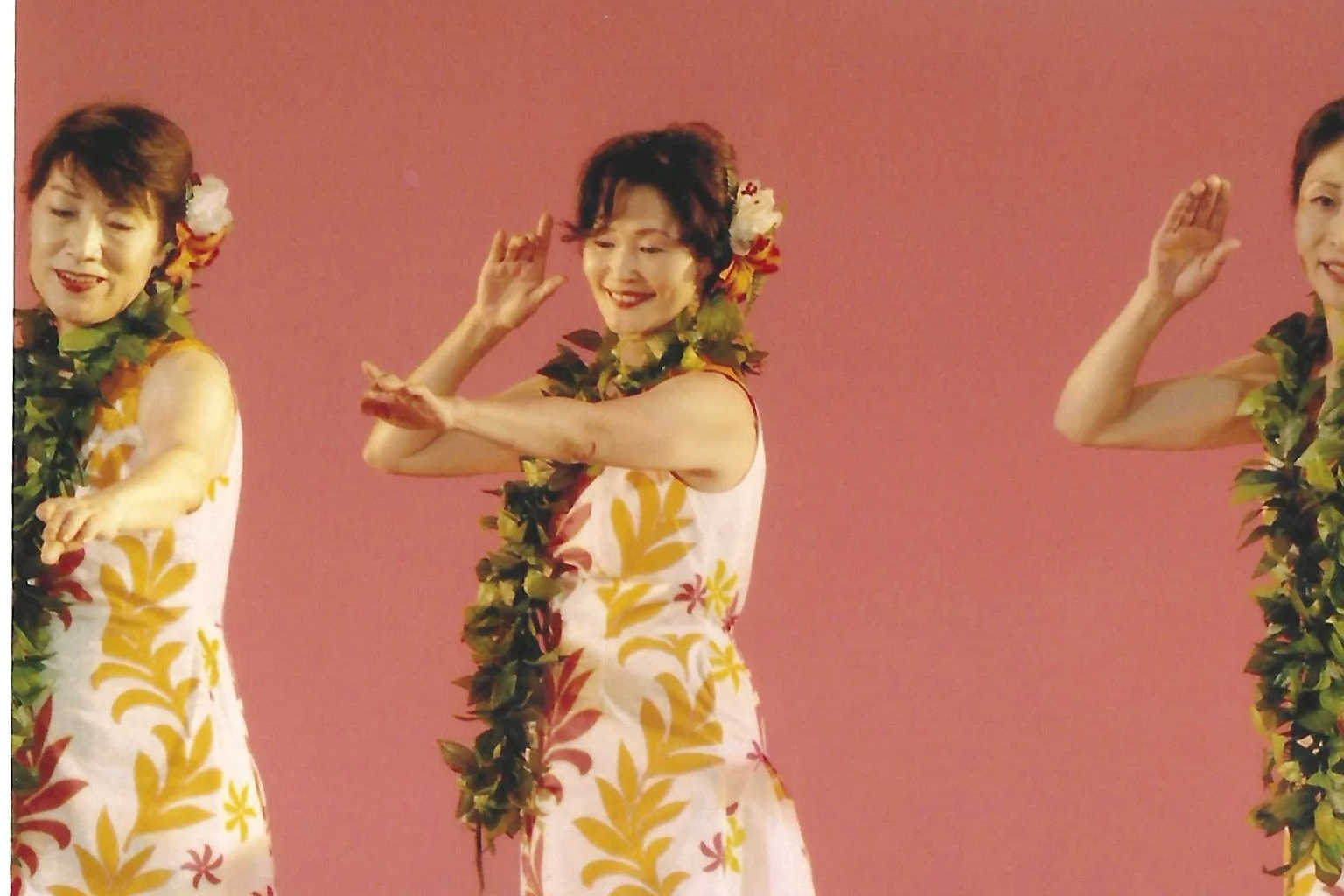
Sakiko performs hula with fellow dancers in Japan. Photo courtesy of the Pierce family.
In 1993, my grandmother Sakiko did something she did not immediately tell her husband or three children: she joined a hula studio.
She was 49 years old. A neighborhood friend had invited her to travel about 20 minutes by train to visit a new dance studio. The studio taught hula, which my grandmother knew mostly through the simplified and sexualized images that had circulated in popular culture. She was curious, but also unsure of what joining the class might suggest to her family and the people around her.
So, at first, she kept it a secret.
This was not simply shyness. Sakiko had spent much of her adult life within a generation where Japanese womanhood was closely defined by marriage, raising children and maintaining a home. Making time for dance, performance and personal expression did not easily fit those expectations.
Still, curiosity drew her onto the train.
A Life Shaped by Expectation
My grandmother’s name carried a history before she was old enough to shape one for herself.
Sakiko was born in an air-raid bunker hospital near the end of World War II. Her given name, written 防子, has been understood in my family as the “defended child.” The first character evokes defense or protection, while the second means child. Her name held the hope of safety during a time marked by war and uncertainty.
As she grew older, her life was shaped by a different set of protections and restrictions. She married, raised three children and carried much of the responsibility of keeping the household together. Her daily life often revolved around the needs of other people.
But identity is never completely fixed. We continually shape it through the choices available to us, even when those choices appear small. Sometimes change begins with a major departure. Sometimes it begins with a weekly train ride to a dance class.
For Sakiko, it also began as a return.
Returning to Dance
As a child, my grandmother had studied nihon buyō (日本舞踊), a form of traditional Japanese dance. Although she remembered being made to attend lessons, she also remembered the love and dedication that grew from them. She performed at community festivals, including Obon, the Buddhist season of remembrance for ancestral spirits.
When her dance teacher died, Sakiko stopped taking classes. For years, she believed that part of her life was over.
The invitation to visit a hula studio brought those memories back. She could remember the discipline of rehearsal, the joy of performance and the feeling of communicating through movement. As she later told me, that childhood experience pushed her curiosity. Until then, she had not imagined that she would dance publicly or perform onstage again.
Her new teacher had studied in Hawaiʻi before returning to Japan. The studio focused on hula ʻauana, a contemporary form of hula that my grandmother experienced through flowing movement, music, colorful dresses and lei.
Hula is a Native Hawaiian cultural practice grounded in language, genealogy, storytelling and relationships to place. My grandmother encountered it through a Japanese studio shaped by the movement of teachers, students and cultural forms between Hawaiʻi and Japan. Her experience was not the whole story of hula, nor was it identical to its practice in Hawaiʻi. It was one personal relationship formed through that movement across cultures.
At 49, Sakiko was one of the younger students in her class. Many of the other dancers were also older women and homemakers. What began as a fun opportunity and a temporary escape from household routines soon became something much larger.
A Life Made Hanayaka
The weekly classes gave Sakiko something that belonged to her.
She practiced movements, learned songs and prepared for recitals. She wore bright dresses and flowers. She developed friendships with other women whose lives had also expanded through the studio. Dance created a place where she could be visible, expressive and part of a community beyond the home.
When I asked how hula had changed her life, she told me:
“I always had a shy personality. I wasn’t the best at expressing myself in words or conversation. But dance and hula helped me express myself. They added rhythm, colors, sensations and lifelong friends to my life. The dresses, flowers, music, movements, practice, recitals and my teacher’s knowledge transformed my life. My life became more hanayaka.”
Hanayaka (花やか) can mean beautiful, brilliant, splendid or showy. Its first character, hana (花), means flower. The word suggests more than beauty alone. It evokes something vivid and radiant, like a life coming into bloom.
That was the word Sakiko chose for what hula gave her.
Her involvement was not a short-lived hobby. She continued dancing for 17 years, finally retiring in 2010 after her last group performance on a hotel stage. Over those years, hula offered rhythm and color, but it also gave her another way to understand herself. It allowed a woman who struggled to express herself in conversation to communicate through her body, clothing, music and relationships with other dancers.
This was not a loud rejection of her responsibilities or family life. It was a steady claim to time, joy and expression within them.
Between Japan and Hawaiʻi
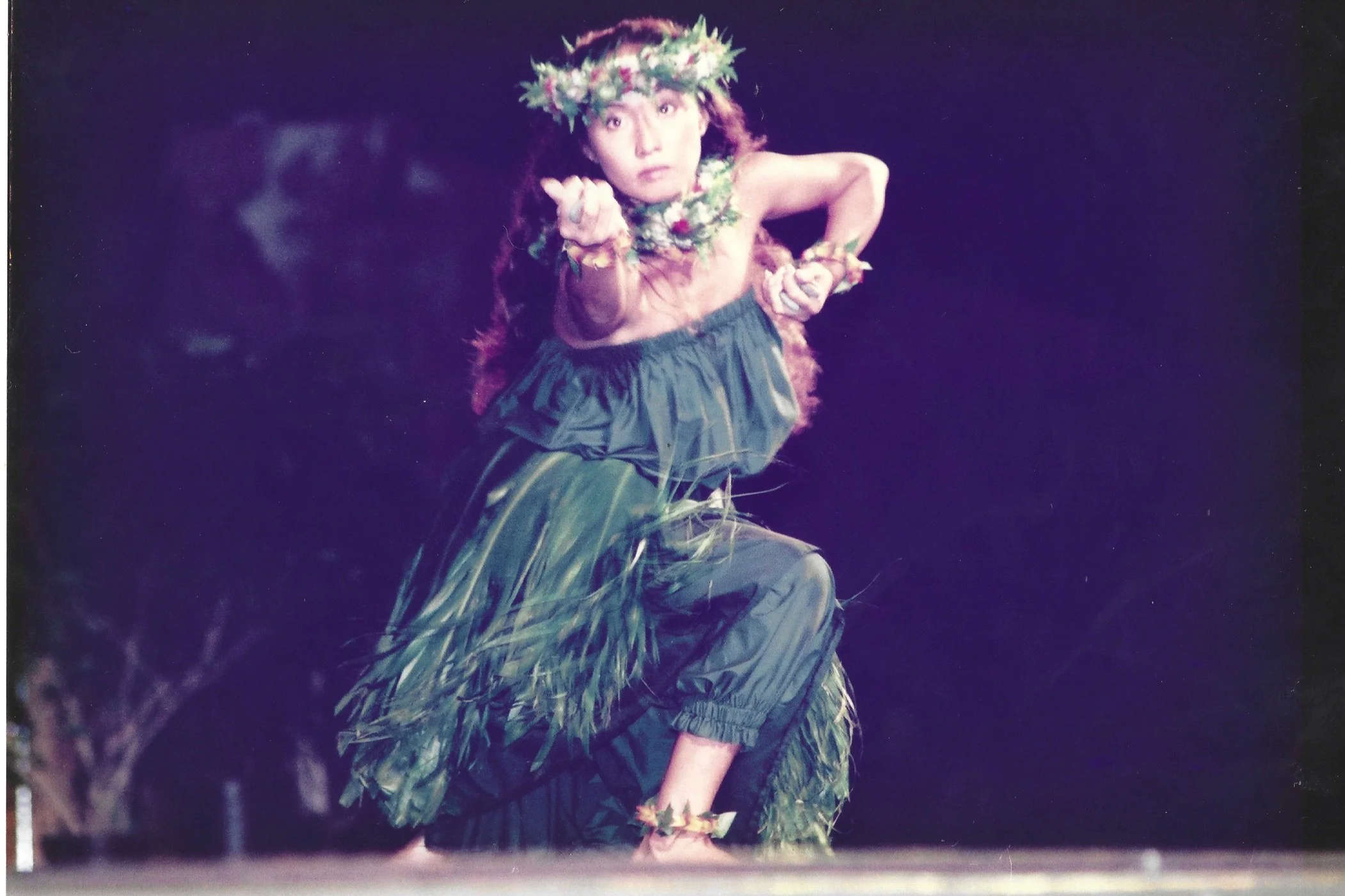
Yumiko Greene performs hula onstage in Hawaiʻi. Photo courtesy of the Pierce family.
Hula would shape the next generation of my family differently.
For my mother, Yumiko, it became more than a weekly practice. In her twenties, she was searching for a life beyond a hostile work environment in Japan and the narrow expectations she encountered as a young woman. An early experience studying in Hawaiʻi, along with her love of dance, showed her another possible path.
In 1996, at age 26, she moved to Oʻahu. There, hula became part of her livelihood and a long-term career.
For my grandmother, hula created room for expression within her life in Japan. For my mother, it helped give her the courage and direction to cross an ocean and begin again. My own life began on Oʻahu, on the other side of that decision.
Their stories reveal two different relationships to the same cultural practice. One woman boarded a train each week and returned to a part of herself she thought she had lost. The other left Japan and built a new home and career in Hawaiʻi. Across three generations, their choices connected our family to both places.
Looking to the Source
There is a Hawaiian expression, nānā i ke kumu, often translated as “look to the source.”
I first approached this story as an anthropology student, using family conversations and academic research to understand my mother’s and grandmother’s relationships with hula. Looking to the source meant listening carefully to their memories. It also meant recognizing that their experiences existed within a much larger history.
Hula cannot be separated from Native Hawaiian people, language, land and cultural knowledge. Its movement to Japan raises complicated questions about translation, interpretation and responsibility. What is preserved when a cultural practice travels? What changes? What do students owe to the people and places from which that practice comes?
My grandmother’s story cannot answer all of those questions, and it is not meant to represent hula in Japan as a whole. It shows what one relationship with hula made possible in one woman’s life. It also reminds me that cultural exchange is most meaningful when we remain attentive to the source, the teachers and the history that made the exchange possible.
Preserving What Moves Between Generations
This project began during the COVID-19 pandemic, when I had not seen my mother or grandmother in more than a year. I originally wrote it as an ethnography, but it was also a letter to both of them and the beginning of a longer effort to preserve our family’s stories.
Years later, that remains the reason I return to it.
My anthropology background taught me to look for meaning in everyday choices, objects, movements and memories. My grandmother’s story lives in all of them: the train she took to class, the flowers she wore, the friendships she kept, the stages she once thought she would never stand on and the Japanese word she chose to describe the transformation.
Sakiko did not become an entirely different person when she began dancing. She recovered and strengthened a part of herself that had been quiet for years.
At 49, she stepped into a studio without knowing that hula would remain part of her life for the next 17 years. In that time, she found rhythm, color, sensation, friendship and a way to be seen.
Hula made her life more hanayaka. By telling her story, I hope some of that color continues moving between generations.
Author’s note: This essay was adapted from a longer ethnographic research project about hula, identity and the women in my family. It reflects my family’s personal experiences and is not intended as a comprehensive history of hula in Hawaiʻi or Japan.